Talking to your daughter about menstruation can raise a lot of questions: When is the right time? How can you explain it without making her feel uncomfortable? What does she need to know before getting her first period?
Menstruation is a completely natural process, and talking about it openly can help girls and teenagers approach their first period with more information, confidence and reassurance. There’s no need to wait until the first bleeding occurs: starting the conversation beforehand can make the experience feel much less confusing.
In this article, we explain how to talk to your daughter about her period, which topics are important to cover and how you can support her during her first menstrual cycles.
When Should You Talk to Your Daughter About Menstruation?
There is no exact age for having this conversation. The best approach is to introduce the topic gradually and adapt your explanations to her age and level of understanding.
Instead of treating it as “the big talk,” it can feel much more natural to use everyday situations as opportunities to bring up the subject. For example, if she asks about menstrual products, hears someone talking about periods, sees a pad at home or becomes curious about changes happening to her body.
The important thing is that she understands what menstruation is before she gets her first period, so that when it happens, she can recognise what is going on and know that it is a normal part of growing up.
How to Talk to Your Daughter About Her Period Naturally
If you’re not sure how to start, one thing can make the conversation much easier: treat menstruation for what it is — a normal bodily process.
1. Use Clear and Simple Language
Explain what happens in the body without relying on metaphors that might make things more confusing.
You can explain that, approximately once a month, the uterus prepares for a possible pregnancy by building up its lining. If pregnancy does not occur, the body sheds this lining, along with blood, through the vagina. This is menstruation.
You can make the explanation more or less detailed depending on her age.
2. Avoid Presenting Periods as Something Negative
Expressions such as “it’s awful,” “that time of the month” or talking about menstruation only in terms of pain and discomfort can cause a girl to develop a negative perception of periods before she has even experienced one.
That doesn’t mean you should hide the fact that periods can sometimes be uncomfortable. Instead, explain that some people experience abdominal cramps, tiredness, mood changes or sensitivity during their period, while others experience very few symptoms.
Every body and every menstrual cycle is different.
3. Give Her Space to Ask Questions
She may have lots of questions, or she may not want to talk much about it at first. Both reactions are completely normal.
Let her know that she can ask you anything and that you can return to the subject whenever she wants. Keeping that door open can be much more valuable than trying to explain everything in a single conversation.
What Should She Know Before Her First Period?
Besides understanding why menstruation happens, it’s important that she has some practical information too.
Explain that during the first months or years, menstrual cycles can be irregular, so her period may not arrive on exactly the same day each month. The amount of bleeding and the duration of her period can also vary from one cycle to another. If she wants to learn more about what to expect, you can also read our guide on the first period and everything you need to know.
This is also a good opportunity to introduce her to the different menstrual products available and explain how they work.
Explain the Different Menstrual Product Options
Pads, tampons, menstrual cups, period underwear… Today, there are many different options available, and learning about them can help her discover what feels most comfortable.
For their first periods, many teenagers may feel more confident using external menstrual products that are simple and easy to use.
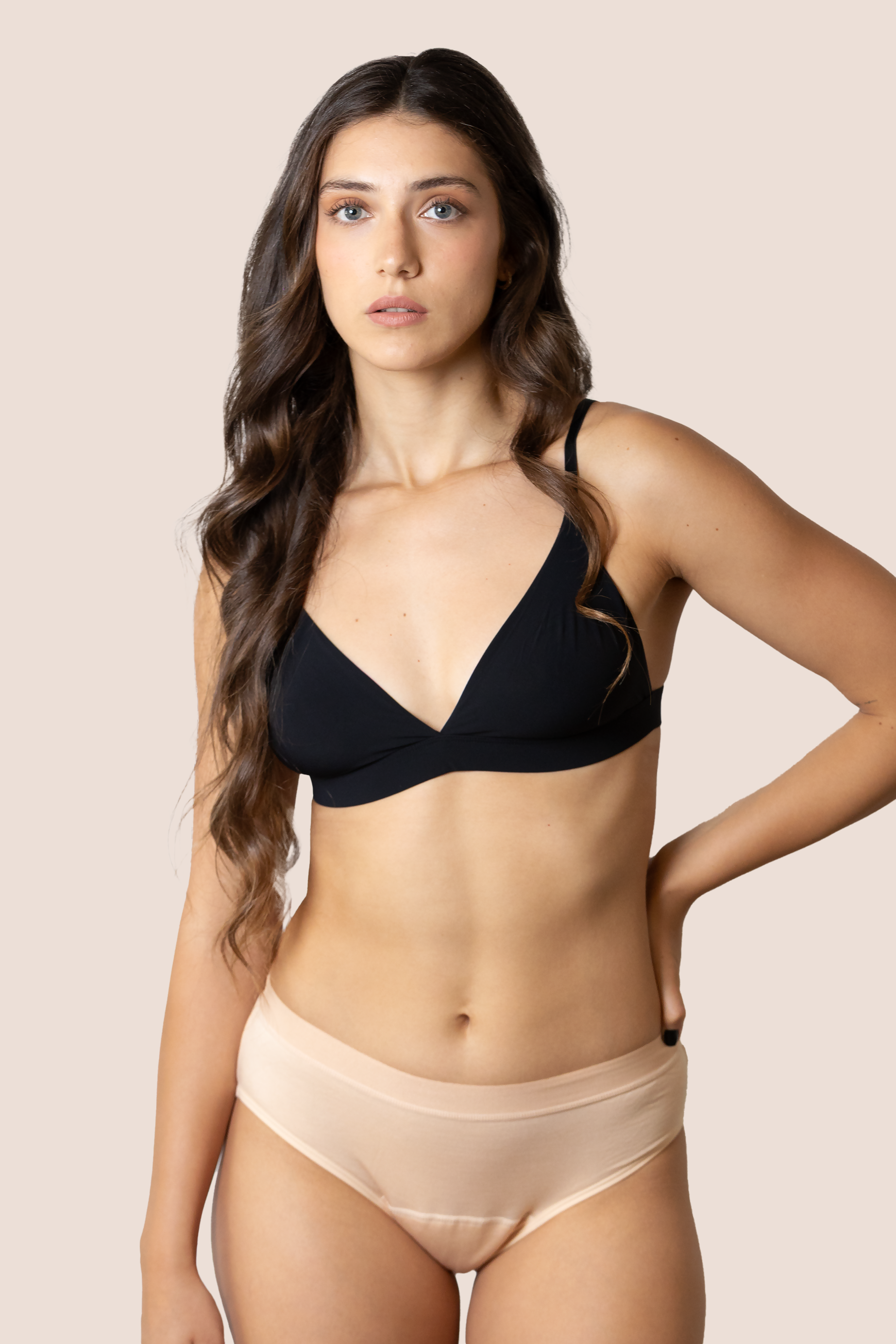
Period underwear for girls can be an especially comfortable option when starting out. It is worn just like regular underwear but contains different layers designed to absorb menstrual flow. This can make going to school, sleeping, exercising or carrying out everyday activities feel easier and more reassuring.
Because there is no internal product to insert or learn how to position, period underwear can also be a practical choice for managing the first few periods.
Show her the different options and allow her to be involved in choosing what she would like to use. Having some control over how she manages her period can help her feel more prepared and confident.
Prepare a Small First-Period Kit
Her first period might start at home, but it could also happen at school, during an activity or while she is spending time with friends.
Preparing a small kit together can give her extra peace of mind. It could include a spare pair of underwear or period underwear, an additional menstrual product and a small bag for storing used clothing if necessary.
It’s also helpful to explain what she should do if her period starts when you’re not with her and which trusted adult she can turn to if she needs help.
Talk About Menstrual Hygiene Too
Learning how to manage a period also involves developing a few basic hygiene habits.
During menstruation, regular intimate hygiene is generally enough. The external genital area can be washed gently, and menstrual protection should be changed as needed.
If she uses period underwear, show her how to wash and care for it correctly so that it maintains its absorbency and lasts as long as possible.
Making these small habits part of her routine can make managing her period feel easier over time.
Normalise the Changes She May Experience
The first period usually happens alongside other changes associated with puberty, such as breast development, body hair, changes in the skin, vaginal discharge and emotional changes.
Talking about these changes can help her understand that her body is going through a gradual process and that there is nothing strange about what she is experiencing.
It’s also important to avoid comparing her development with that of other girls. Some will get their first period earlier, while others will get it later.
What If She Feels Embarrassed to Talk About Periods?
There’s no need to force the conversation.
You can give her age-appropriate books or resources, answer her questions whenever they arise and show through the way you talk about menstruation that periods are not a taboo subject.
Trust develops gradually. Knowing that she can come to you with questions without feeling judged can make a significant difference when she experiences something new or has concerns.
Supporting Her Also Means Teaching Her to Understand Her Body
Knowing how to talk to your daughter about her period doesn’t mean having all the answers or explaining absolutely everything in one conversation.
It’s about creating a space where she feels comfortable asking questions, understanding what is happening in her body and approaching her first menstrual cycles with information and reassurance.
Talking openly about menstruation at home can help break down taboos and encourage younger generations to develop a healthier and more conscious relationship with their menstrual cycle.
At Ecowoman, we believe that understanding our bodies is also a way of taking care of them. Supporting a first period with information, empathy and products she feels comfortable using can turn an unfamiliar experience into a new stage she can approach with confidence.